Ruled by Our Human Emotions - Happiness


Happiness is a  co-dependent emotion.  It is completely and totally dependant upon a right set of circumstances.  The right gift.  The right friendship.  The right marriage.  The right home.  The right job.  The right small group.  The right relationship with your kids.  The right car.

The list is endless.


Let one piece of our circumstances change and our happiness meter gets totally out of whack.

I even hear my little girls say, "I'm not happy."  

And when I inquire as to why, they say, "Btuz I want that doll," or "Btuz I want apple juice."

Even in their short-lived lives, they have learned that happiness, their happiness, is dependant upon getting what they want or what they think they need.

We, as adults, are equally conditioned to think that our happiness is dependant upon getting what we want or think we need.

But happiness is fleeting and fickle and self-serving. 


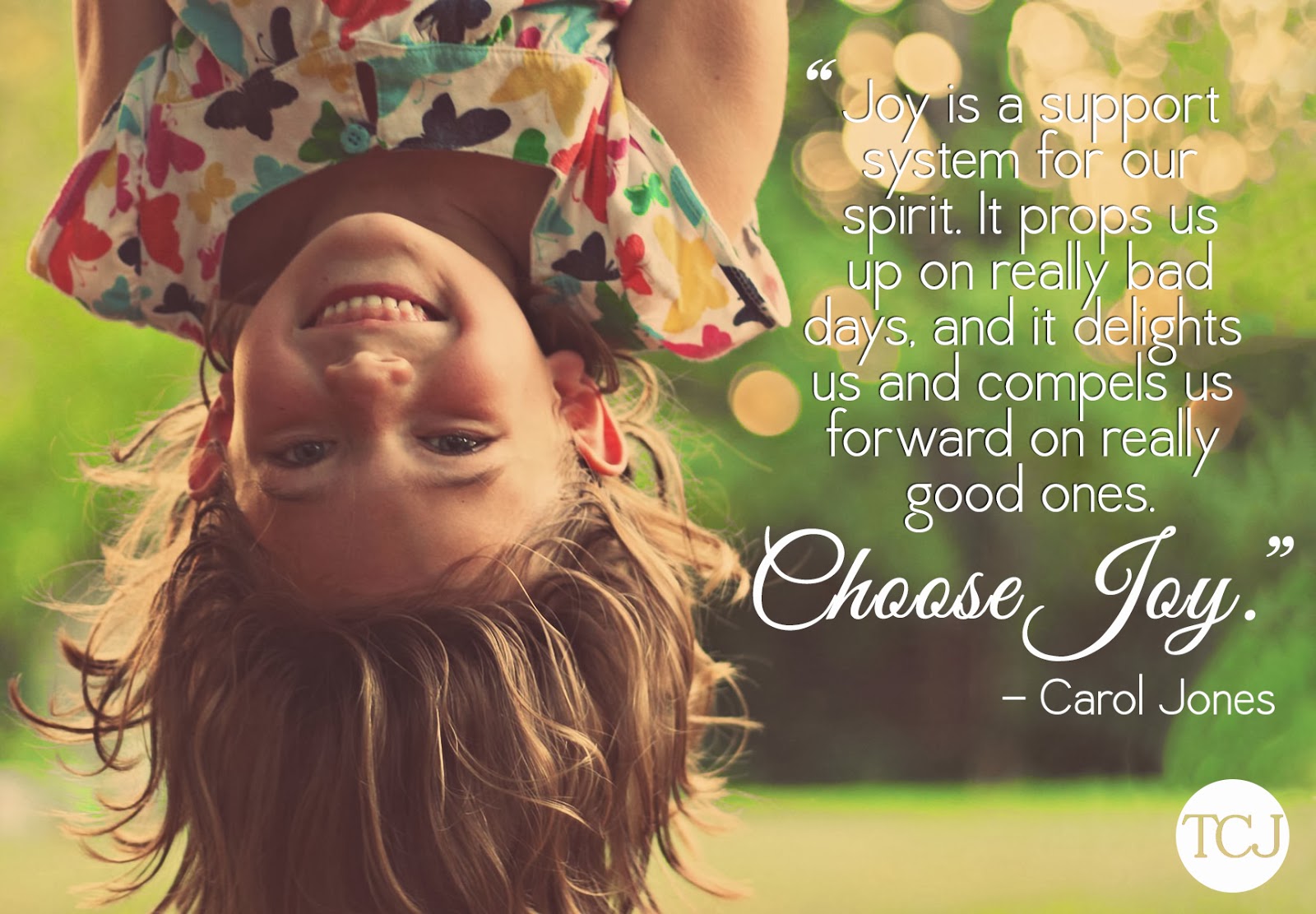
Joy, on the other hand, is completely different than happiness.  Joy is a contentment that defies the weighty gravity of conditional happiness.  It's an inner peace that passes all understanding.  It's a support structure for our spirit.  It props us up on really bad days, and it delights us and compels us forward on really good ones.

Joy is a gift that we are given.  A gift we must receive.  But sadly, we miss the precious, soul-feeding contentment of joy because we are so freaking caught up in worrying about our happiness.


All that to say, happiness is fleeting and self-serving.  Choose joy.


Just out of curiosity, what makes you happy, 
and what brings you joy?

Catalyst: Session 6 - Reggie Joiner


Reggie Joiner
Founder and CEO
Rethink Group

Your Days Are Numbered. 
Be Known For What Matters


We all know our days are numbered, but to see a visual representation of that is both sobering and inspiring.  When Reggie Joiner stepped out onto the Catalyst stage, he did so carrying a giant jar of marbles, a representation of the life of our children, specifically, but a broader representation of our life in general.

When you realize how much time you have left, when you see it as a jar of marbles, you tend to pay attention to what matters most.  This makes you focus on the things you can do, the things you were made to do, and not just the things you think you should do.

Leaving a Legacy


We all think about what we will leave behind when we are gone.  We want to leave a legacy, a tiny piece of us, which will be remembered for generations. Joiner reminded us, in bullet point fashion, of some important legacy truths.


Truth #1 – Legacy is not the same thing as inheritance.  Inheritance is what you leave “for” people, but a legacy is what you leave “in” people.


Truth #2 - The people who will remember you are the people who know you now.  (Not the virtual friends you have on social media, or the people you hope to someday impress, but your children, your family, your true friends)

Truth #3 – You will leave what you model, not what you lecture.


Truth #4 – Legacy is less about you being magnificent and more about you being ordinary and dependable.

And lastly, Joiner reminded us of the Principle of Over Time.

The Principle of Over Time


Progress is measured “over time”  Life is richer “over time.” Relationships are different “over time.”

Love
Time = Worth

Fun
Time = Deeper Relationships/Connection

Stories
Time = Deeper Perspective.

And at the end of the day what you do week after week after week is what matters.

All that to say, go, be ordinary and dependable.  And do it over and over and over. Leave a legacy.

Catalyst: Andy Stanley - Known Survivor


Andy Stanley,                                                                         Sr. Senior Pastor, North Point Church
Known Survivor                                                         Surviving Your Appetite for Known

Catalyst is known for a lot of things. Leadership, Powerful worship, incredible messages. skinny jeans and hipsters. So it should come as no surprise, that Andy Stanley, Mr. Session One himself, would throw all grammatical convention to the wind and use the word KNOWN as every form of speech possible.


Everyone has an appetite for known.


If you feed your appetite for known it grows. And no matter how much you feed it, you will never have enough known.  You never fully satisfy your appetite, no matter what.

You can overfeed your appetite for known, and if you aren’t careful, the need will eventually tip you over.

There is no amount of known that will ever be enough to satisfy your need to be known.

So How much known is enough?  You will never have enough known.


The Three Laws of Know

What’s applauded as exceptional the first time will be expected the next time.
Your desire to be known will drive you to do things you never ever thought you’d do until you get a little bit of recognition.  A little bit of known. And then it’s expected you’ll keep on doing it.

Applause is intoxicating
Those most applauded will feel the most entitled to it.
You think you should get something no body else should get.

Applause is addictive
We start looking for it
We start manufacturing it
And if it gets out of hand, you become a victim of known.

So here’s the tension:
To lead, you must be known.  You have been called to be known.   The question is, how do we keep known from ruining us?


The Answer Is In The Bible
Mark Chapter 4

The whole Judean countryside and all the people of Jerusalem went out to hear John the Baptist (thousands and thousands of people)

He goes from obscurity to everyone coming to see him.  Suddenly he is a phenomenon.  He is known.

Everyone asks him if he is the Messiah or Elijah.  He repeatedly answers “no” and they ask him “WHO are you?”  He said, “I am the voice of one calling in the wilderness, make straight the way of the Lord.”

He was saying, "I am a directional sign. I’m just here to point you in the right direction.”

The next day John saw Jesus coming toward him and said,  “Look. . . the lamb of God comes to take away the sins of the world.”

It happened again the next day.  And when John’s two disciples heard him say, “look” they looked and followed Jesus.  His disciples left him and followed Jesus.

His other disciples came to him and said, “Rabbi (talking to John the Baptist) that man (Jesus) who was with you yesterday, he’s over there and he’s baptizing and everyone is going to him.”

Basically they were saying, “He’s totally stealing your show.”

John’s disciples were worried that they were losing followers.

But Here Was John’s Profound Answer because he understood known.

“A person can receive only what is given him from heaven.”

The Lord gives and the Lord takes away.  Blessed be the name of the Lord.

He was saying, “Do you think I am known for any other reason than because God ordained that I would be known so that He can be known?” 


What is the Application for Us?

In our lives and our minds, as long as we are growing, succeeding, doing well at work, have perfect kids, etc. it’s all for the glory of God.  But when things go downhill, we start going into problem solving mode.  We can’t lose our “known.”

But if we could remember that we receive “known” because we can only receive from heaven what heaven decides to give.


Want to survive being known?

Remember who it’s from and who it’s for.  Your appetite for known will never be satisfied by a number.

All that to say, wouldn’t it be so great if we could be so blessed by the amount of known that Jesus gave us and didn’t get jacked up because of it . . . didn’t think we were something special because of it?  Then we’d never have to worry about losing it because we’d know we’d done what we were supposed to with the amount of Known that God gave us.

Never forget that the applause isn’t for you.

32 Years to the Same Man?


I was talking with a young woman a few weeks ago about marriage and conflict and conflict resolution.  


She asked me, "How have you done it for 32 years?  Stayed married?"

I said, "That's easy.  When I have days that are incredibly good or devastatingly bad, there is one person I want to run to, and that's my husband."


Mike and I are 32 years older than we were on the day we married.    In some ways, we are completely different people than we were then.  People change.  Life changes us, often in ways we would never expect.

And the truth is, some days marriage is hard.  After 32 years, I am often surprised that we argue about the same damn things we argued about in our first year of marriage.  Seriously.  We do.  Arghhh!

On more than one occasion, my husband has not lived up to my very high expectations of him, and I am quite certain that I have failed to meet his expectations as well.

 And yet . . .

One Thing Remains


At our core, one thing remains.  We love each other.  For better, for worse, for richer, for poorer, in sickness and in health, til death do us part. That, my friends, is a rich love that withstands all the crap that life can throw at it.

There is a worship song I love that says,

Your love never fails
It never gives up
It never runs out me


Though I know the words to the song are about Jesus, I believe this is the same love Mike and I pledged to each other on the day we were married. (I technically also pledged to obey. I'm not doing so well in that area! HA!)


I love you Mike Jones, for so many reasons.  I hope you always know how much I love you.

(And in case you forget, just think about how awesome I am in bed!)

All that to say, Happy Anniversary Mr. Man.  I love you.

Don't Let Anger Steal Another Minute of Your Life


I have written and rewritten this opening paragraph more times than I care to think about. I think my struggle has been to write about anger in a real, personal way that is both transparent and helpful and yet honors the right to privacy of others. Sometimes a fine line to walk, you know? 

In deciding to write a blog series about our human emotions, I knew there would be subjects that would be hard to talk about because they involve some fairly deep-rooted and not altogether pleasant memories for me. And at the end of the day, I don't know that I WANT to write about them, nor do I know if you NEED to read about them. 

So how do I write about anger?  I've written about anger before, many times in fact.  I've written about the physiological effects of anger. I've written about anger in your marriage.  I've even written about losing your temper (which isn't so much anger as it is a lack of self-control).


REAL ANGER


But the anger I am talking about is the kind that is deep-seated, often rooted in unforgiveness of an event or a lifetime of events.  The anger I'm talking about bubbles to the surface in ways that are often shocking to the person who is angry as well as the people caught in the wake of their anger.

It's that anger that is crushing and cruel and has one purpose; to seek retribution for the pain and injustice that caused its birth in the first place.

I've known many angry people in my lifetime.  Many.  Too many for one lifetime, to be sure. But every angry person I have ever known shares one characteristic; they have been hurt, badly and deeply, and they don't have a clue how to free themselves from the bondage of that pain.  So they lash out.  

Some lash out physically, some verbally, often without provocation, always with devastating effects to the people in their lives.


THE SOURCE OF ANGER


I learned from an incredible friend and valued mentor that the source of anger, real anger, is unforgiveness.  Getting to the place where you can identify the core of your own anger is very, very difficult and very, very necessary.

I recently had a long talk with a friend of mine who grew up in a very angry home.  He was beaten, shouted at, ridiculed and betrayed by the very people who should have been his protectors, a fact that birthed in him an anger that eventually consumed him and the people around him.

What I learned about him as we talked was that though he felt he had forgiven his abusers, he could rattle off a list of offenses so quickly and with such deep emotion, that it surprised even him.  


Find the source of the pain, find the source of the anger.


We hold onto anger because it makes us feel powerful and invincible.  It's our way of shouting, "I will never be hurt again." Maybe we don't realize that's what we're shouting, but it is.  

We hold onto anger (or more accurately, unforgiveness) because it lets us feel we hold a debt over those whom have hurt us, a debt from which they will not easily be released.  For in releasing them, we fear we give them power to hurt us all over again.

But anger is a thief.  It is born of unforgiveness and hatred, and it robs us of many things, the greatest of which is freedom.

If you are angry, I have to ask you, do you feel free or do you feel imprisoned?  


WHAT WILL YOU CHOOSE?


Anytime I feel anger over something; deep, real anger, I have to ask myself, what am I so mad about?  Is this thing I am blowing up about the root of my anger, or a symptom of a deeper issue?  And once explored and defined, I ask myself these questions:


  • Will I harbor bitterness and unforgiveness, or will I freely forgive others?
  • Will I continue to be angry, or will I release myself from the bondage of my anger?


Indeed, will I choose bondage or freedom?  Because ultimately, that's what my choices will lead me to, either bondage or freedom.


But here is our promise:


Galatians 5:1 "But it is for freedom that Christ has set us free . . ."

Christ HAS set us . . . me . . . free.  Not Christ "will" set me free, but he "HAS" set me free. I am already free. Any bondage I choose to live in, is then, of my own choosing.

All that to say, I hope you will choose freedom over anger.  And once chosen, I hope you will walk in that freedom. For it is a choice.